
What happened: Attendees at ARTBA’s May 15-16 Federal Issues Program (FIP) participated in a healthy dialogue with federal and state agency officials on key issues vital to transportation development. The FIP was followed by the May 16-17 Transportation Construction Coalition (TCC) Fly-In, featuring House Transportation & Infrastructure (T&I) Committee Chair Sam Graves (R-Mo.) and Ranking Member Rick Larsen (D-Wash.), Senate Environment & Public Works Committee Ranking Member Shelley Moore Capito (R-W.Va.), and Sen. Kyrsten Sinema (I-Ariz.)
What was discussed: The annual gatherings allowed ARTBA members to meet with their elected officials and provided updates on Infrastructure Investment and Jobs Act (IIJA) issues, including:
- How states are utilizing IIJA Funds: New Jersey’s Department of Transportation (NJDOT) Assistant Commissioner Parth Oza said the IIJA has made a significant impact on the state’s construction activity. What he needs urgently are qualified transportation engineers to fill an ‘experience age gap’ of 50 years. The IIJA is providing ‘a wide variety of training opportunities that help us develop the next generation of professionals.’
- The need for permitting reform. All four federal legislators at the TCC Fly-In noted their desire to see projects move through the federal permitting and review process faster and pointed to a growing congressional sentiment on both sides of the aisle for further reforms.
- ‘Buy America’ clarification. Federal Highway Administration (FHWA) Construction Team Leader Brian Hogge engaged in a detailed dialogue on current policy issues at his agency, including the challenges of implementing the newest domestic preference requirements. Corey Walker, director of the Office of Capital Project Management at the Federal Transit Administration (FTA), briefed members on the agency’s extensive work program generated by the IIJA’s record investment.
- Developing a ‘safety culture.’ Maryland’s Montgomery County Division Chief of Traffic Engineering & Operations Michael Paylor, noting the rising tide of highway worker and traffic fatalities, listed several obstacles to roadway worker safety that must be addressed: limited roadway closure and traffic detours; barrier deflections of more than four feet; misplaced truck mounted attenuators; and the extra cost of ‘bidding safety.’ Executives of ARTBA affiliates also reported on growing momentum for automated speed enforcement in work zones.
Key takeaway: A key theme from the FIP and TCC Fly-In: show how the IIJA is improving people’s lives. ‘We need to talk more about the value of the IIJA and what it means to our communities,’ said Utah Department of Transportation (UDOT) Executive Director Carlos Braceras. ‘The public needs to understand and appreciate what they’re getting for it. They want to hear how it’s making their lives better.’
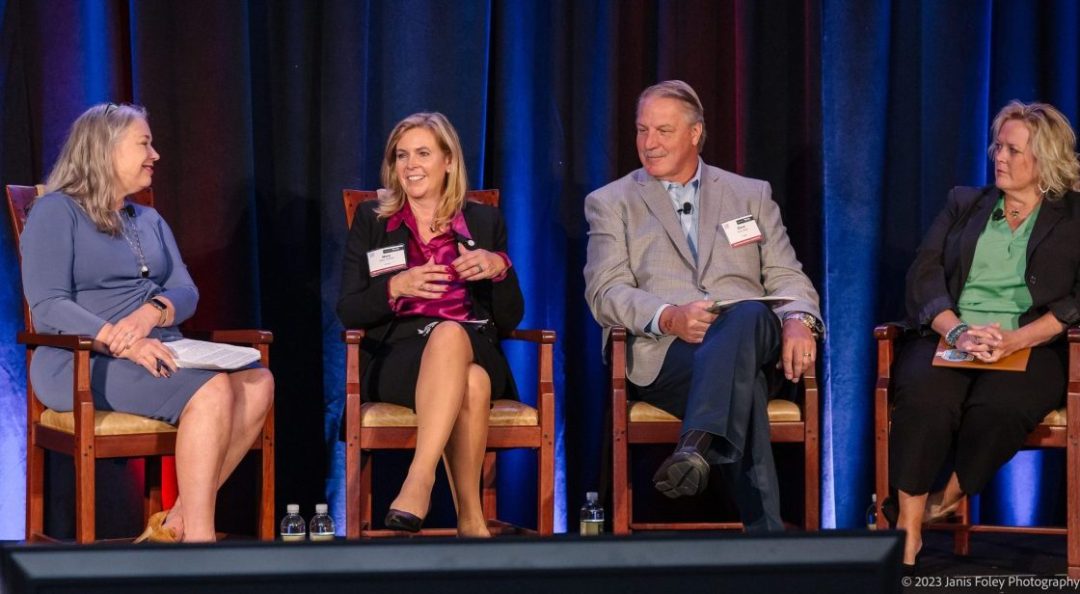
Pictured above, left to right: ARTBA Chief Economist Dr. Alison Black, UDOT Executive Director Carlos Braceras, NJDOT Assistant Commissioner Parth Oza, and ARTBA Chair Paula Hammond (WSP USA) discussed how states are utilizing IIJA funding. Photo by Liz Roll for Max Taylor Photography.

Related News
Transportation CEOs Discuss Pandemic Effects, Workforce Issues, and Cyber Security Challenges
What happened: CEOs of three top transportation construction and design companies Sept. 11…
Basketball Great Bill Walton Headlines ARTBA National Convention Sept. 10-13
What’s happening: National Basketball Association (NBA) Hall of Famer Bill Walton will keynote…

ARTBA Chair & Utah DOT Executive Director Talk Project Delivery During U.S. DOT Webinar
What happened: The U.S Department of Transportation’s (U.S. DOT) new Project Delivery Center…